Every founder who comes to us with an AI product idea asks some version of the same question: "should we fine-tune a model, or use RAG?" The honest answer is usually neither, or both, depending on what's actually failing.
These three approaches solve different problems. Treating them as interchangeable — or worse, picking the one that sounds most sophisticated — is how teams burn months and budget chasing the wrong fix.
What each approach actually does
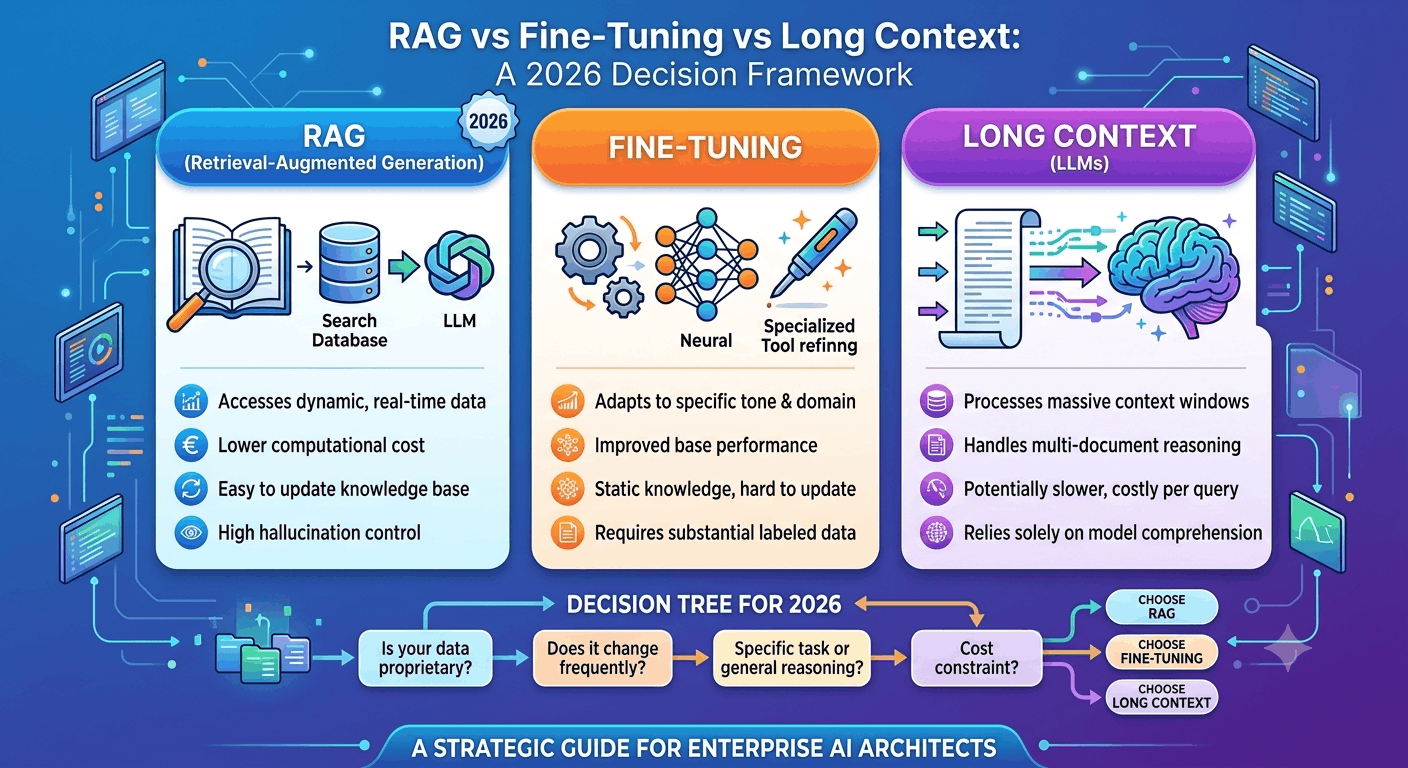
Retrieval-Augmented Generation (RAG) retrieves relevant information at query time and injects it into the model's context. The model's weights never change — you're giving it better source material to reason over.
Fine-tuning updates the model's weights on your own examples. You're changing how the model behaves, not what it knows in the moment — it gets better at a task, a tone, a format, or a style.
Long context skips retrieval and fine-tuning entirely, and just stuffs more raw information directly into the prompt. With modern context windows reaching hundreds of thousands of tokens, this is now a real option for problems that used to require RAG.
The mistake we see most often: a team has a knowledge problem and reaches for fine-tuning, or has a behavior problem and reaches for RAG. Neither works, because the tool doesn't match the failure mode.
The decision framework
| If your problem is… | Use this | Why |
|---|---|---|
| The model doesn't know your data | RAG | Retrieval injects current, specific facts at query time |
| Your knowledge base changes frequently | RAG | No retraining needed when source data updates |
| The model knows the facts but answers in the wrong tone or format | Fine-tuning | Tone and format are behavioral, not knowledge problems |
| You need consistent structured output at scale | Fine-tuning | Bakes the format into the model instead of relying on prompt instructions every time |
| Your knowledge base is small and stable (under ~100K tokens) | Long context | Skip the retrieval infrastructure entirely |
| You need the model to reason across an entire document, not just retrieve snippets | Long context | RAG retrieves chunks; long context sees everything at once |
| You need source attribution and auditability | RAG | Retrieved chunks give you a paper trail; fine-tuned weights don't |
| Latency and cost per query matter most | Fine-tuning or RAG with a small index | Long context is the most expensive and slowest option per query at scale |
Why RAG is still the default for most products
For the majority of AI products we build — internal knowledge assistants, customer support bots, document Q&A — RAG remains the right starting point. The reasons are practical, not theoretical.
Your data changes. Product docs get updated, policies shift, new content gets published. With RAG, your index updates and the model immediately has access to current information. With fine-tuning, every meaningful update means a new training run.
You need to know where an answer came from. RAG gives you the retrieved chunks alongside the answer, which means you can show citations, debug bad answers by inspecting what was retrieved, and build user trust through transparency. A fine-tuned model's knowledge is baked into weights you can't inspect.
You're not trying to change how the model behaves — you're trying to give it information it doesn't have. That's exactly what RAG is built for.
When fine-tuning is actually the right call
Fine-tuning earns its place when the problem is behavioral, not informational.
Consistent output format at scale. If you're generating thousands of structured outputs — extraction into a fixed schema, classification into specific categories, code in a specific style — fine-tuning bakes the format in. You stop paying the token cost of detailed formatting instructions on every single call, and you get more consistent adherence than prompting alone delivers.
Domain-specific tone or voice. Legal, medical, and brand-specific writing tasks often need a voice that's hard to fully specify in a prompt. Fine-tuning on examples of the target voice gets you there more reliably than prompt engineering.
Reducing latency and cost per query. A fine-tuned smaller model that's been taught your specific task can often outperform a larger general model with a long, detailed prompt — and it's cheaper and faster per call. This matters a lot at high query volume.
Specialized reasoning patterns. Some narrow technical domains benefit from teaching the model your specific reasoning patterns directly, rather than hoping few-shot examples in the prompt generalize correctly every time.
The honest caveat: fine-tuning requires a real training dataset — typically hundreds to thousands of high-quality examples — and an evaluation process to confirm the fine-tuned model is actually better, not just different. Teams that skip the eval step regularly ship regressions they don't catch until production.
When long context replaces RAG entirely
Long context windows have changed the calculus for a specific category of problem: small, stable, and answer-requires-everything.
If your entire knowledge base fits comfortably in context — a product spec, a single codebase, a contract — and it doesn't change often, skipping retrieval infrastructure entirely can be the simpler, more reliable choice. You avoid retrieval failures (the right chunk wasn't retrieved), you avoid chunk-boundary problems (the answer spans two chunks that weren't retrieved together), and the model can reason over the full document instead of a handful of snippets.
The tradeoff is cost and latency. Sending 100K+ tokens on every single query is expensive at volume, and processing time scales with context length. Long context wins on quality for the right problem shape, but loses badly on unit economics if you're running it at high query volume.
A pattern we've used in production: long context for low-volume, high-stakes queries where answer quality matters most (contract analysis, due diligence document review), and RAG for high-volume, latency-sensitive queries (customer-facing chat).
They're not mutually exclusive
The most resilient production systems we've built use these techniques together, not as a single choice.
A common pattern: RAG for retrieval, feeding into a fine-tuned model that's been taught to reason over retrieved context in your specific domain's style. The fine-tuned model handles the "how to respond" problem; RAG handles the "what do you know" problem.
Another pattern we use for document-heavy workflows: long context for the initial pass over a full document, with RAG as a fallback for cross-document queries that exceed what fits in a single context window.
Treating these as a stack of complementary tools — rather than competing options you pick once and commit to — is what separates AI systems that hold up in production from ones that were architected around whichever approach was trending when the project started.
How we approach this with clients
Before recommending any approach, we run a simple diagnostic: is the failure mode a knowledge gap, a behavior gap, or a reasoning-scope gap? That single question eliminates most of the ambiguity.
Knowledge gap — the model doesn't have the facts — points to RAG. Behavior gap — the model has the facts but responds wrong — points to fine-tuning. Reasoning-scope gap — the model needs to see everything at once to answer correctly — points to long context.
Most production AI systems end up using two of the three. The mistake isn't picking the "wrong" one; it's picking only one and forcing it to solve a problem it wasn't built for.