A support engineer pings you: "the agent did something weird with a customer's account." You pull up the logs. There's an API call, a 200 response, and no record of why the agent decided to make that call in the first place.
This is the failure mode that defines production AI agents: the system did exactly what it was told to do at every step, and the outcome is still wrong, and nobody can explain why without re-running the whole thing and guessing. Traditional application debugging — stack traces, breakpoints, reproducible inputs — assumes deterministic code. Agents reason, and reasoning isn't deterministic in the way a function call is.
If you're building agent systems and treating observability as something to add later, you're setting up a debugging session that takes days instead of minutes the first time something goes wrong in production.
Why agent debugging is different
A traditional bug has a reproducible path: same input, same code, same output, every time. You can bisect, add a breakpoint, and find the line that's wrong.
An agent bug often doesn't reproduce. The same input can take a different reasoning path on a re-run, call a different tool, or produce a subtly different output — because the underlying model isn't deterministic even at low temperature, and because agent state accumulates across multiple steps where small variations compound.
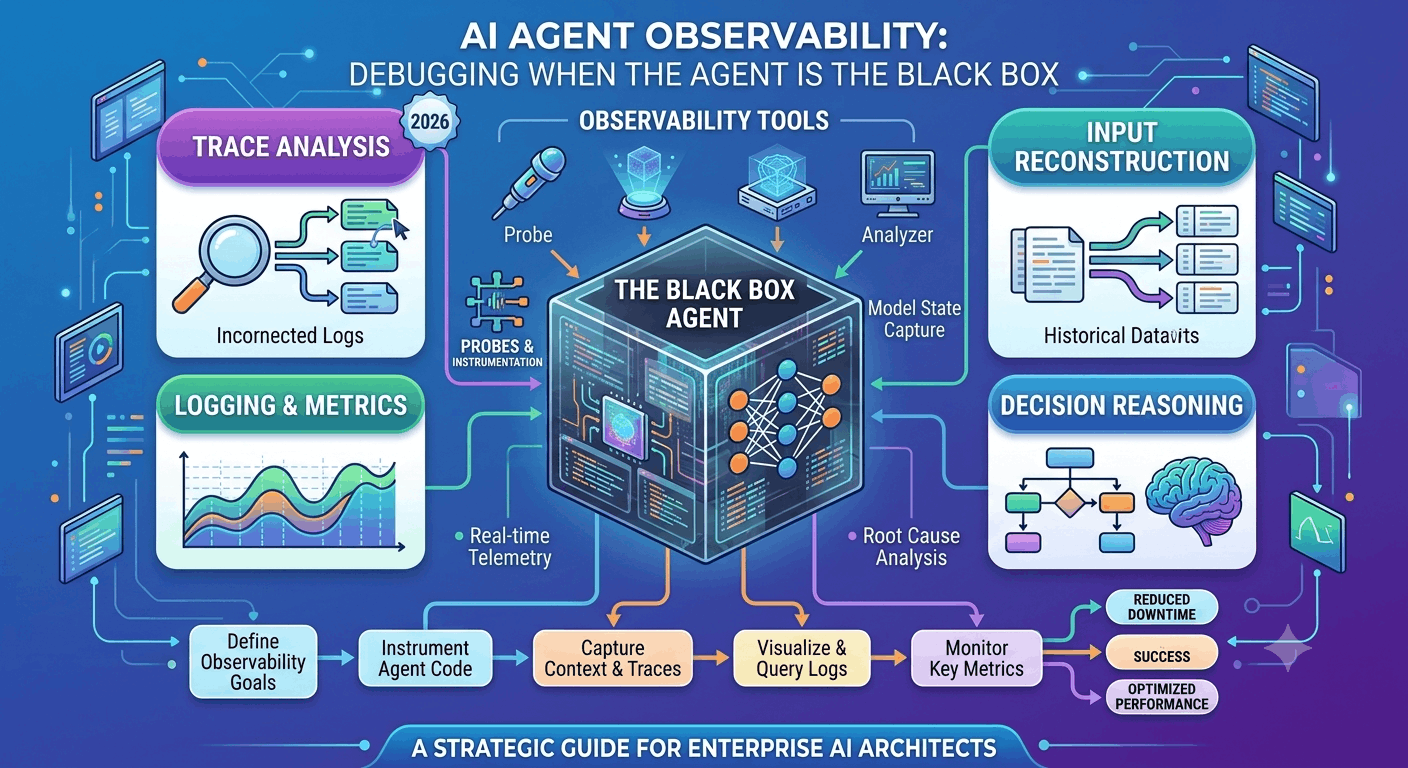
This means the debugging question changes. It's not "what line of code caused this" — it's "what sequence of decisions led here, and was each decision reasonable given what the agent knew at that point." Answering that requires capturing the full decision trail, not just the final output.
What to actually log
Logging the final output and a generic error message tells you almost nothing. The decision trail is what matters.
| Layer | What to capture | Why it matters |
|---|---|---|
| Input | The exact prompt, retrieved context, and tool definitions available at each step | Reproduces the conditions the agent was reasoning under |
| Reasoning | The model's intermediate reasoning output, if exposed | Shows why it chose an action, not just what action it chose |
| Decision | Which tool was called, with what parameters | The actual action taken — this is what causes real-world side effects |
| Tool result | Raw output returned from the tool call | Confirms whether the agent's action succeeded or the agent misjudged a failure as success |
| State transition | What changed in the agent's state after this step | Lets you replay the full execution from any checkpoint |
| Retry / branch | Whether this step triggered a retry, fallback, or human escalation | Surfaces silent failure recovery that would otherwise hide a real problem |
The principle underneath all of this: log enough that you can replay the agent's execution from any point without re-running the live system. If your only record of a failure is a vague application log line, you've built a system you can't debug.
Tracing across multi-step and multi-agent flows
For single-call AI features, observability is close to standard API logging. For multi-step agents — and especially multi-agent systems — you need distributed tracing applied to reasoning, not just network calls.
Each agent execution should produce a trace with a unique ID, and every step within that execution — every LLM call, every tool invocation, every state update — should be a span within that trace. In multi-agent systems, when one agent hands off to another, the trace ID propagates across the handoff so you can follow a task across agent boundaries instead of staring at disconnected logs from three different services.
Frameworks like LangGraph expose this kind of step-level visibility natively when paired with a tracing tool like LangSmith — every node execution, state transition, and LLM call shows up as part of a single coherent trace. If you're hand-rolling agent orchestration without a framework, you're rebuilding this tracing infrastructure yourself, and it's easy to underestimate how much of it you actually need until the first production incident.
Evaluation isn't a one-time gate — it's a running signal
Most teams run evals once before launch, treat it as a checkbox, and then have no signal when behavior drifts in production. That's backwards. Production agents need evaluation running continuously, not just pre-launch.
Golden dataset regression tests. A fixed set of inputs with known-good expected outcomes, run on every change to a prompt, model version, or tool definition. This catches regressions before they ship, the same way unit tests catch code regressions.
Production sampling. A percentage of real production traces, reviewed — by an automated judge model, a human, or both — against quality criteria. This is how you catch drift that golden datasets miss, because production inputs are messier and more varied than any test set you wrote in advance.
Outcome tracking, not just output quality. Did the agent's action actually achieve the intended business outcome? A response can look fluent and well-reasoned and still be the wrong action. Tying evaluation to downstream outcomes — did the support ticket get resolved, did the extracted data match the source document — catches failures that text-quality evaluation alone misses entirely.
Designing for graceful failure, not just visibility
Observability tells you what happened. It doesn't prevent the failure from mattering. The systems that hold up in production are designed so that when the agent is wrong, the blast radius is small.
Confidence thresholds with fallback to human review. If the agent's output includes a confidence signal — or you derive one from retrieval relevance scores or self-consistency checks — route low-confidence outputs to a human queue instead of executing automatically.
Bounded retries, not infinite loops. An agent that retries a failing action indefinitely doesn't just waste tokens — it can compound a single bad decision into dozens of bad side effects. Cap retries explicitly and route to human review on exhaustion.
Irreversible actions get a checkpoint. Anything consequential and hard to undo — sending an email, writing to a production database, executing a financial transaction — should pause for approval rather than executing autonomously. This is a design decision, not an observability feature, but it's the single highest-leverage thing you can do to limit the cost of an undetected reasoning failure.
Dead-letter queues for agent failures. When an agent execution fails in a way it can't recover from, it should land somewhere a human can inspect and resolve — not silently drop, and not silently retry forever.
What this looks like in a real incident
A document-processing agent extracts structured data from invoices, validates it against a schema, and writes confirmed results to a database. One day, extracted totals start being off by small, inconsistent amounts.
With proper tracing, this is a fast investigation: pull the trace for an affected document, see the model's reasoning for that field, see the raw OCR text it was working from, and see that the OCR output had a formatting artifact the model was misreading. Fix the upstream OCR step, re-run the golden dataset to confirm the fix, ship it.
Without tracing, this is a multi-day investigation: re-running the agent on sample documents and guessing, trying to spot a pattern in inconsistent outputs, eventually finding the OCR issue mostly by chance. The difference isn't the bug — the bug is the same either way. The difference is whether your system can explain itself when something goes wrong.
The standard to build toward
The bar for a production agent system isn't "it works most of the time." It's "when it doesn't work, an engineer who didn't build it can find out why in minutes, not days." That standard is achievable — but only if observability is part of the architecture from the start, not bolted on after the first incident makes the gap obvious.